

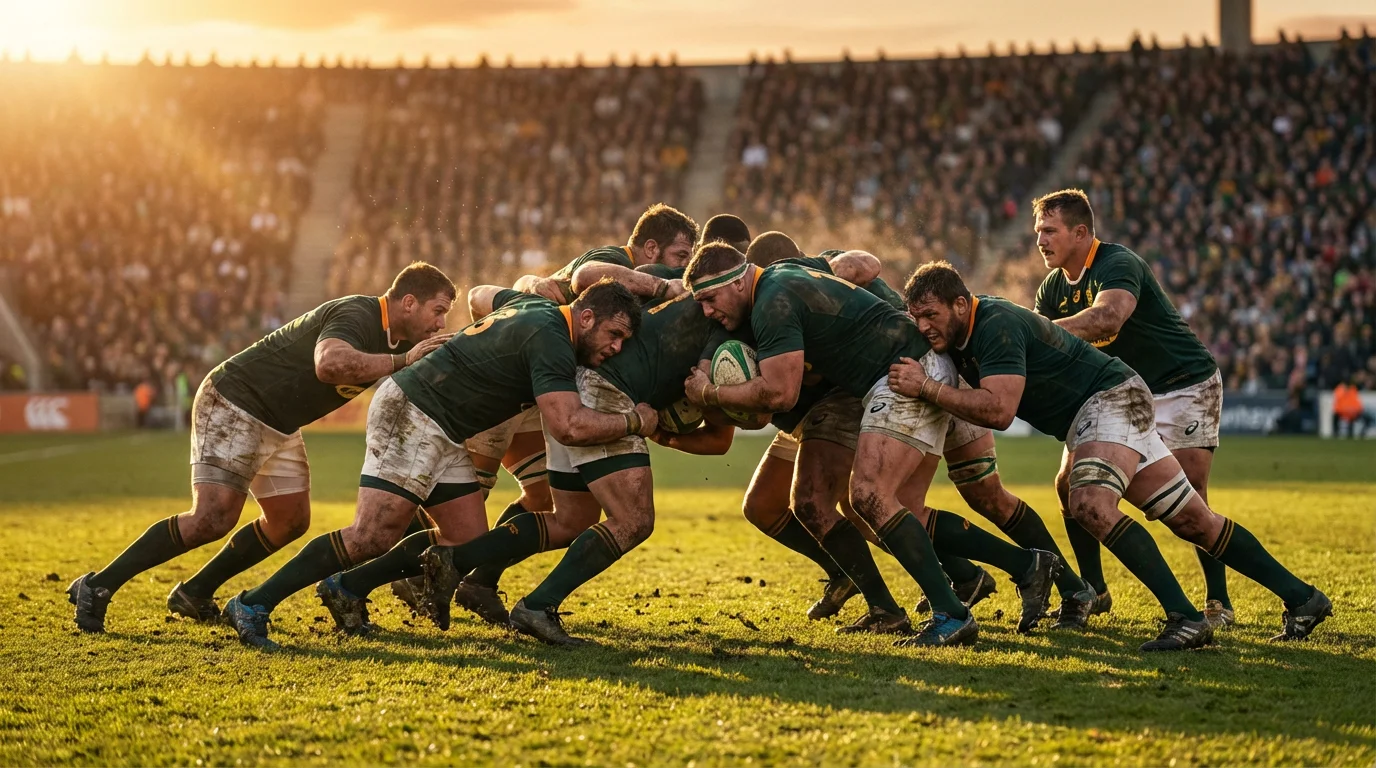
No team has ever won three consecutive Rugby World Cups. South Africa, after back-to-back titles in 2019 and 2023, stand on the edge of history. The Springboks’ recent dominance has been built on the most physically imposing forward pack in rugby, a tactical system that prizes territory over possession, and a depth of squad that allows them to effectively field two different teams. Betting on South Africa to complete the three-peat is betting on a team that has proven it can win the biggest games in the sport. But it’s also betting against history, against the natural cycles of squad regeneration, and against the reality that every team in the world will be specifically preparing to beat them.
South Africa Springboks 2027 on rugby world cup betting.
The Blueprint That Won Back-to-Back Titles
South Africa’s World Cup victories in 2019 and 2023 followed remarkably similar blueprints. Rassie Erasmus, whether as head coach or director of rugby, built a system centred on forward dominance, a ferocious defence, and a kicking game designed to strangle the life out of opposition attacks. The Springboks didn’t always play the most entertaining rugby, but they played the most effective rugby when it mattered. Both finals were tight, physical affairs decided by margins that reflected South Africa’s superior conditioning and big-match temperament.
The 6-2 bench split, using six forwards and only two backs among the replacements, became the Springboks’ signature innovation. This approach allowed them to maintain, and even increase, their forward intensity in the second half while opponents wilted. The “Bomb Squad” front row, a second set of props and hooker who could match or exceed the starting trio, meant that South Africa effectively had no drop-off in scrummaging power for the full eighty minutes. Other nations have tried to replicate this strategy, but none have matched the depth of forward talent that makes it work.
The tactical foundation also relied heavily on the boot. Whether it was Handre Pollard or Damian Willemse directing operations, the Springboks used their fly-half primarily as a territory manager, kicking for position and letting the forwards turn field position into points. This approach is the antithesis of the All Blacks’ running game, and it’s precisely why it works at World Cups. When the pressure is at its highest, the team that controls territory and minimises risk tends to prevail. South Africa have turned this principle into an art form.
The Ageing Squad Problem
The biggest challenge to South Africa’s three-peat bid is biology. Several players who were central to the 2019 and 2023 campaigns will be approaching the twilight of their careers by October 2027. Eben Etzebeth, the totemic lock who has been the heartbeat of the Springbok pack, will be 36. Siya Kolisi, the inspirational captain, will be 36. These aren’t peripheral figures. They’re the emotional and physical leaders of the squad.
The retirement and natural decline of experienced players creates gaps that can’t simply be filled by inserting the next man in line. International rugby at World Cup level demands a combination of talent, composure, and big-match experience that takes years to develop. South Africa’s system is designed to mitigate individual reliance, but there’s a difference between replacing a good player and replacing a generational leader. The Springboks’ challenge is doing both simultaneously across multiple positions.
That said, South African rugby possesses a conveyor belt of physically gifted players that keeps the system fed. The provincial structure, the competition between the Bulls, Sharks, Stormers, and Lions in the United Rugby Championship, and the sheer number of South Africans playing professional rugby in Europe means that the talent pool is deep. The question isn’t whether South Africa can find replacements. It’s whether those replacements can perform under the unique pressure of a World Cup knockout match with a three-peat on the line.
Coaching Continuity and the Erasmus Factor
Rassie Erasmus remains the most influential figure in South African rugby, and his continued involvement in the 2027 cycle is a significant factor for bettors to consider. Erasmus operates as a director of rugby rather than a traditional head coach, giving him strategic oversight while delegating day-to-day coaching. This structure has proven effective because it allows Erasmus to focus on big-picture planning, opposition analysis, and the psychological preparation that has been a hallmark of South Africa’s recent success.
The coaching system Erasmus has built is not dependent on any single individual, but it is shaped by his vision. The emphasis on forward power, the 6-2 bench strategy, and the tactical kicking game all bear his fingerprint. If Erasmus remains in place through 2027, the Springboks will arrive in Australia with a settled system, a clear identity, and the tactical flexibility to adapt to different opponents. This continuity is a competitive advantage that most other nations don’t possess.
There’s also the motivational dimension. Erasmus is a master of using external narratives, whether it’s perceived disrespect, media criticism, or refereeing controversies, to fuel his squad’s siege mentality. The three-peat narrative itself becomes a motivational tool. No team has done it. The world expects you to fail. Everyone wants to be the team that stops you. For a group of South African players raised on a culture of proving doubters wrong, this is rocket fuel.
Betting the Springboks: Market Position and Value
South Africa will be priced as one of the top two or three favourites for the 2027 World Cup. Current futures markets have them trading around +250 to +350, similar to New Zealand, reflecting both their recent dominance and the uncertainty around squad transition. The implied probability at +300 is 25%, which for a team attempting something unprecedented might actually be generous.
The case for backing South Africa rests on system over individuals. If you believe that the Erasmus-built machine can absorb the loss of ageing stars and continue to produce the same suffocating rugby, then the current odds represent fair value. The counter-argument is that the system has never been tested without its cornerstone players at a World Cup, and history shows that defending champions rarely win the next tournament. Only New Zealand (2011 and 2015) have managed back-to-back, and nobody has done three in a row.
The timing of your bet matters significantly. If South Africa dominate the 2026 Rugby Championship with a refreshed squad, the odds will shorten and the value will evaporate. Conversely, if they struggle during the transition period, losing matches they would previously have won, the market will overreact and push their odds out to +400 or beyond. That overreaction is where the smart money enters. The Springboks’ system is built to peak at World Cups, not at annual tournaments, and a poor Rugby Championship is not necessarily predictive of World Cup performance.
Matchup Concerns in Australia
South Africa’s World Cup record in the Southern Hemisphere is strong, but playing in Australia presents specific challenges. The Springboks thrive in conditions that suit their forward-heavy approach: slow pitches, cold weather, and closed-roof stadiums where the atmosphere amplifies their physical dominance. Australia in October offers the opposite. Fast, dry surfaces in Sydney and Perth favour running rugby. Open-air stadiums with firm pitches reward teams that can move the ball through hands.
The matchup against the hosts is particularly concerning. Australia under Joe Schmidt have rebuilt with an emphasis on structured play and clinical execution, and a Wallabies team with home support on a fast track is a more dangerous proposition than their world ranking might suggest. If the draw produces a Springboks-Wallabies knockout match in front of 80,000 screaming Australian fans, the conditions will be stacked against South Africa’s preferred game plan.
France present the other significant threat. The French pack has grown into a genuine rival to South Africa’s forward dominance, and if the two meet in the knockout stages, it becomes a battle of attrition where the Springboks’ traditional advantage is neutralised. Add in the fact that France will be hungrier than ever after their agonising home World Cup exit in 2023, and you have a matchup that the odds may not fully account for.
Where to Find Springbok-Related Value
The outright market is not the only way to bet on South Africa’s campaign. Pool stage matches against lower-ranked teams will feature large handicap lines, and the Springboks’ professionalism in dispatching weaker opposition is well-established. If South Africa are giving 30+ points in a pool match, their depth and bench strategy often produces comfortable covers that make handicap betting relatively safe.
The more interesting angle is betting against the three-peat in specific markets. If you believe the ageing squad and Australian conditions will conspire against South Africa, opposing them in the match markets during knockout games against fellow Tier 1 nations could be the sharper play. The Springboks will be respected by the market in these matches, meaning their opponents may offer more attractive odds than their genuine chances warrant.
Player prop markets also deserve attention. South African wingers have historically been prolific World Cup try-scorers, thanks to the team’s ability to create wide overlaps through forward dominance. If Cheslin Kolbe or his successor on the wing is available at long odds for the tournament’s top tryscorer, that represents a value angle driven by the team’s system rather than individual brilliance.
The Weight of History
Three consecutive World Cup titles would be the greatest achievement in rugby history, surpassing even New Zealand’s back-to-back in 2011-2015. The weight of that expectation is both a motivator and a burden. South Africa’s players will carry the knowledge that they’re attempting something no team has accomplished, and that awareness will intensify with every match they win.
See also New Zealand 2027.
For bettors, the three-peat question comes down to a single assessment: do you trust the system more than you fear the circumstances? The Erasmus machine is the most refined tournament operation in world rugby. But the players who powered it are ageing, the conditions in Australia don’t favour their style, and every opponent will have four years of footage and analysis dedicated to finding cracks. Backing South Africa at the right price is not a bad bet. But the right price needs to account for the mountain they’re climbing, because no team has ever stood at this summit before.
