

If you are coming to the Rugby World Cup from a rugby league betting background, everything looks familiar until it is not. The ball is the same shape, the field is roughly the same size, and the objective — crossing the try line — is identical. But the rules governing how you get there are different enough to make your league betting instincts actively misleading when applied to union. And if you are a union bettor looking at league markets, the reverse is equally true.
The differences between the two codes are not cosmetic. They cascade through every aspect of match dynamics: scoring patterns, game tempo, the role of set pieces, the frequency of turnovers, and the structure of defensive systems. Each of these factors feeds directly into how betting markets are priced, and a punter who does not understand the distinctions is bringing a league knife to a union gunfight, or vice versa.
This article maps the key differences between rugby union and rugby league as they relate to betting. It is written for punters who are fluent in one code and curious about the other, with a particular focus on what league bettors need to know before wagering on the 2027 Rugby World Cup.
Rugby union vs league on rugby world cup betting.
Scoring Systems and What They Mean for Totals
The scoring difference is the first thing crossover bettors notice. In rugby union, a try is worth five points, a conversion two, a penalty goal three, and a drop goal three. In rugby league, a try is worth four points, a conversion two, a penalty goal two, and a field goal (drop goal) one. The arithmetic shapes everything.
Union matches tend to produce fewer tries but more total points from kicks. A tight union test match might finish 21-18 with four tries and a stack of penalty goals. A tight league match might finish 18-16 with four tries and minimal kicking. The over/under market reflects these tendencies, and crossover bettors who anchor to league scoring expectations will consistently misjudge union totals lines.
Penalty goals are the critical divergence. In union, teams frequently opt to kick three-point penalties rather than pursue a try from a penalty advantage. This tactical choice inflates the total score without increasing the try count, which means a union match that finishes 30-20 might contain only six tries — fewer than a league match that finishes 22-14. For totals bettors, this means the point total and the try total are only loosely correlated in union, whereas in league they track much more closely.
Drop goals also play a different tactical role. In union, a well-timed drop goal can be match-deciding in a tight knockout contest — Jonny Wilkinson’s 2003 World Cup final winner is the canonical example. In league, the field goal is a single point and typically a last-resort tactic. For bettors in the correct score and winning margin markets, understanding that union matches can shift by three points on a single drop goal attempt adds a layer of volatility that league markets do not carry.
Set Pieces: The Engine Room That League Lacks
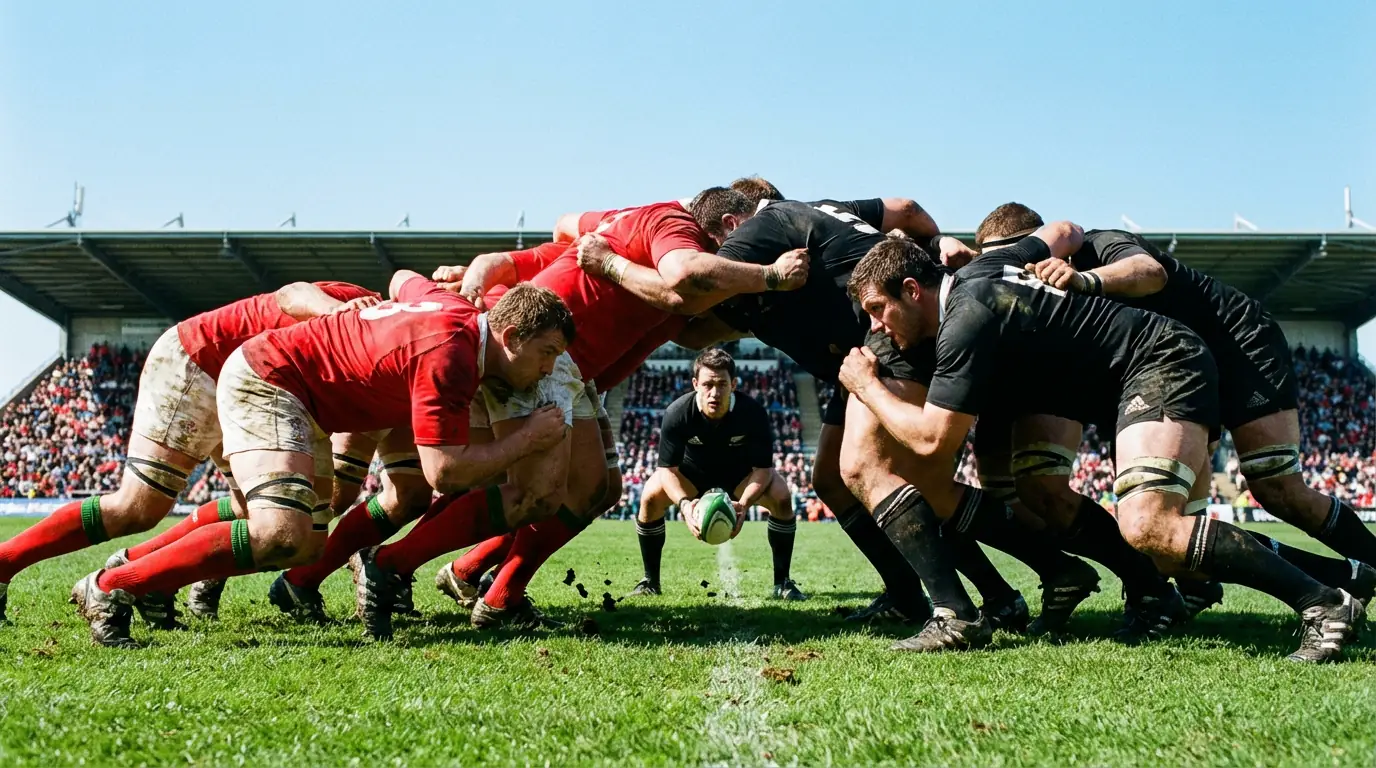
The most fundamental tactical difference between the two codes is the role of set pieces. Union is built on contested scrums and lineouts. League has uncontested scrums that are essentially restarts and no lineouts at all. This difference is seismic in betting terms.
In union, the scrum and lineout are platforms for attacking play and sources of penalties. A team with a dominant scrum can win penalty after penalty against a weaker pack, accumulating points through goal kicks and building field position without needing to run the ball. A team with a precise lineout can launch maul drives that produce tries from close range. These set-piece dynamics have no parallel in league.
For bettors, this means union handicap lines are influenced by forward matchups in ways that league lines are not. A union team might be objectively weaker in open play but cover the handicap because their scrum earns a stream of penalties. A league bettor who analyses only backline quality and ignores the pack is missing the dominant variable in many union matches.
Lineout steals are another union-specific factor. A team that consistently disrupts the opponent’s lineout is effectively creating turnovers at a rate that league’s structured possession system does not allow. These turnovers suppress the opponent’s scoring opportunities and tilt the match toward the team with the better lineout, which has direct implications for both handicap and totals markets.
Turnovers, Possession, and Tempo
In rugby league, possession is structured. A team receives six tackles (plays) to advance the ball, then typically kicks on the sixth tackle, handing possession to the opposition. This structured alternation means possession is roughly 50/50 in most league matches, and the tempo is relentlessly high because there are no contested breakdowns to slow the game.
Union is chaos by comparison. Possession is earned through contested rucks, turnovers at the breakdown, and set-piece wins. A dominant team can hold possession for extended periods — five, ten, even fifteen phases without losing the ball — while a weaker team might go through entire halves with minimal attacking opportunities. Possession statistics in union are volatile and meaningful, whereas in league they are relatively stable and less informative.
For bettors, this difference matters in live betting. In league, a team that trails by twelve points at halftime is not desperately disadvantaged because the structured possession system guarantees they will have the ball roughly half the time in the second half. In union, a team that trails by twelve points and is being dominated in the ruck and scrum may never see enough possession to mount a comeback. The live handicap in union should be more aggressive than in league for the same halftime deficit, because the mechanisms for regaining possession are less reliable.
Tempo differences also affect totals betting. League matches move faster, with shorter intervals between plays and less dead time. Union matches stop frequently for scrums, lineouts, TMO reviews, and injury assessments. A union match is scheduled for 80 minutes but the ball is in play for approximately 35-40 minutes. A league match puts the ball in play for 50-55 minutes. More ball-in-play time means more scoring opportunities in league relative to union, and crossover bettors need to recalibrate their mental model of how much scoring action fits into the clock.
Defensive Structures and Handicap Implications
The defensive systems in each code are fundamentally different, and this has direct implications for how handicap lines behave.
League defence is a flat line that rushes up to meet the ball carrier with coordinated speed. It is highly structured, rehearsed, and difficult to break through with conventional phase play. When league defences fail, it is usually because of individual brilliance — a broken tackle, a perfect offload — rather than a systemic breakdown.
Union defence is layered. Teams defend in a wider variety of formations — pillar-post systems, blitz defences, drift defences — and the defensive challenge is more complex because the attacking team has more options at the breakdown. Union defences can be manipulated through set-piece moves, switch plays, and the threat of the kicking game, which creates space in ways that league’s structured tackles do not.
The implication for handicap betting is that big margins in league are rarer than in union. League’s structured possession ensures the weaker team always has opportunities to score, which compresses scorelines. Union’s open possession structure allows dominant teams to suffocate opponents by holding the ball for long periods and converting territorial advantage into points. A 40-point handicap in a union mismatch is harsh but plausible; in league, a margin beyond 30 is uncommon even in heavily lopsided matches. Crossover bettors from league who see a -35 handicap in a union pool match should not assume it is an outlier — it may be the market’s honest assessment.
Market Structure and Availability
The betting market infrastructure differs between the codes in practical ways that affect your World Cup experience. Union markets at major bookmakers are typically deeper during World Cup periods than at any other time, with a full menu of match-level and tournament-level props. League markets are generally consistent year-round because the NRL and Super League provide regular weekly fixtures.
One area where league bettors have an advantage is familiarity with in-play betting rhythms. League’s structured phases make live betting more predictable in some respects — you know when the ball will change hands, you can anticipate field position, and the scoring rhythm is steadier. Union’s in-play markets are more volatile because turnovers and penalties arrive unpredictably. If you are a league bettor transitioning to union live betting, expect wider price swings and more frequent market suspensions.
Two Games, One Oval Ball, Zero Overlap in Strategy
The common ancestry of rugby union and rugby league creates a false sense of familiarity that has separated many crossover bettors from their money. The codes share a vocabulary but speak different languages. Tries, tackles, kicks, and conversions mean different things in different contexts, and the betting markets that surround each code reflect those differences with precision. If you are bringing league knowledge to a World Cup bet slip, slow down. Study the scrum. Watch the lineout. Count the penalties. The game you think you understand is not quite the game being played, and the market is priced for people who know the difference.
See also understanding odds formats.
