
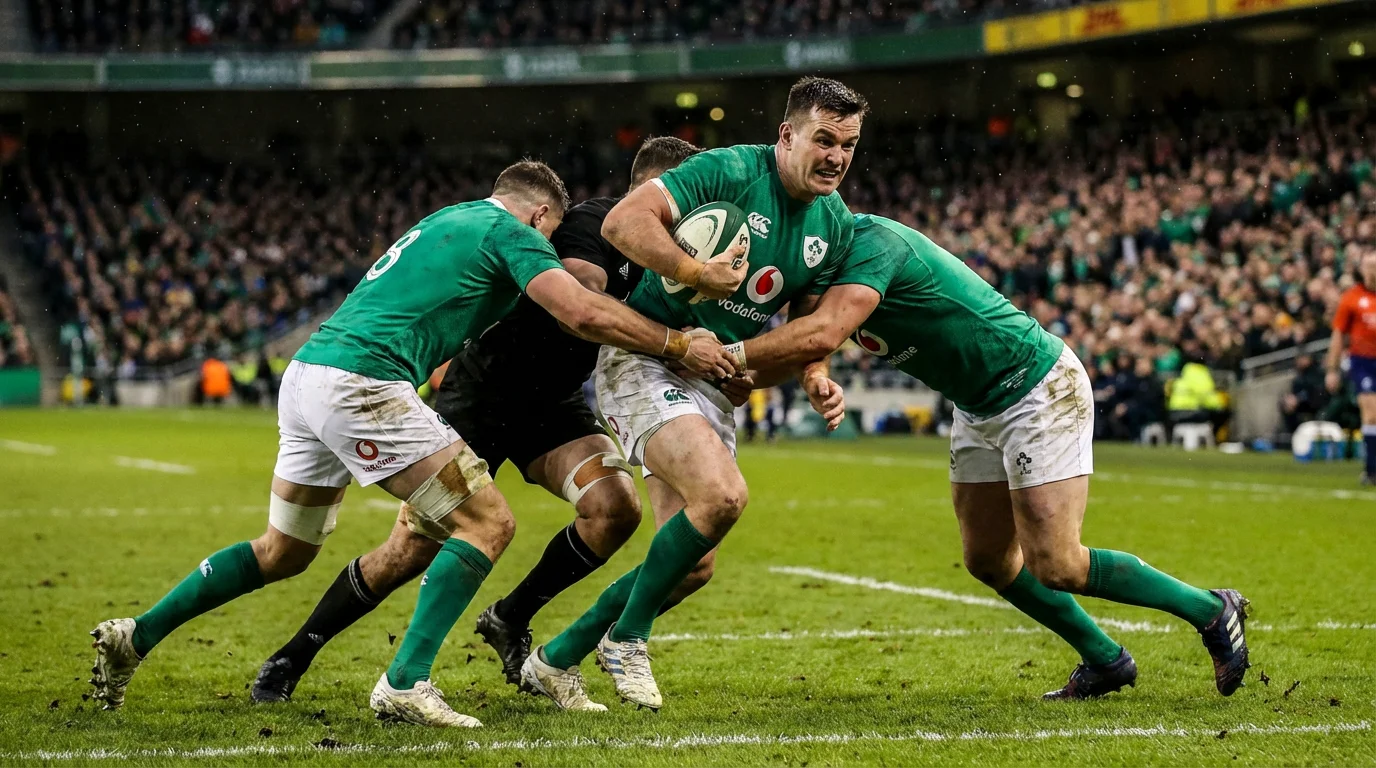
Irish rugby exists in a state of permanent contradiction. During the regular international calendar, Ireland routinely beat the best teams on the planet. They win Six Nations titles, they top world rankings, they produce moments of breathtaking collective brilliance. Then the World Cup arrives, and something breaks. The pattern is so consistent it almost feels scripted — and for bettors, that script is the single most important factor when pricing Ireland’s 2027 chances.
The question heading into Australia is not whether Ireland have the talent. They do. It is whether the tournament itself is a psychological wall they cannot climb, or whether the generational shift that followed Johnny Sexton’s retirement has finally freed them from decades of accumulated scar tissue.
A History Written in Quarter-Final Defeats
Ireland’s World Cup record reads like a case study in underperformance relative to expectation. In ten tournaments from 1987 to 2027, they have never reached the semi-finals. The 2023 result was particularly cruel because Ireland had entered as the world’s top-ranked team and favourites, had beaten the All Blacks during the pool stage, looked imperious doing it, and then lost to New Zealand in the quarter-finals when the knockout rounds began.
Before 2023, the list of quarter-final exits includes losses to Wales in 2011, Argentina in 2015, and New Zealand again in 2019. The 2015 tournament stands out because Ireland arrived as Six Nations champions, lost their talismanic captain Paul O’Connell to injury during the pool stage, and then collapsed against a rampant Argentina side in Cardiff. Each cycle follows a familiar arc: dominance in the build-up years, genuine belief heading into the tournament, and then a single devastating result that ends everything.
The psychological dimension cannot be overstated. Other teams have bad tournaments. Ireland have a bad tournament every time. South Africa lost to Japan in 2015 and still won the whole thing four years later. England were eliminated in their own pool in 2015 and reached the final in 2019. Ireland’s pattern is unique in its consistency, and that consistency is precisely what makes it relevant to anyone placing a bet on the 2027 edition.
The Post-Sexton Era: Liberation or Void?
Johnny Sexton retired after the 2023 World Cup, and with him went the last link to the generation that built Ireland’s modern identity. Sexton was more than a fly-half — he was the emotional engine of the team, the player who dragged Ireland to victories they had no business winning and who embodied the fierce intensity that defined their best performances. His absence created an immediate question: could Ireland maintain their level without the player who set that level in the first place?
The early evidence from the 2024 and 2025 Six Nations campaigns suggests the answer is complicated. Ireland remain competitive, still capable of beating anyone on their day, but the aura of invincibility that surrounded the 2022-2023 team has faded. Jack Crowley has settled into the fly-half role with growing authority, bringing a different energy — calmer, more measured, less combustible than Sexton. Whether that temperament is an advantage or a disadvantage in the pressure cooker of a World Cup knockout game remains to be seen.
Andy Farrell’s coaching tenure provides continuity, and his record in developing depth across the squad has been one of the genuine positives of the post-Sexton period. The pack remains formidable, with Leinster and Munster continuing to produce high-quality forwards at a rate that belies Ireland’s relatively small playing population. The backline has evolved too, with more pace and offloading ability than previous Irish teams typically carried. The question, as always, is not about regular-season capability but about whether this group can do what no Irish squad has done before: win three consecutive knockout games at a World Cup.
Squad Depth and the Provincial Pipeline
One area where Ireland have genuinely improved is squad depth. The days when losing one or two key players meant the entire campaign unravelled are, theoretically, behind them. The provincial system — anchored by Leinster’s dominance in European competition and Munster’s resurgence — produces a conveyor belt of international-calibre players that few nations of Ireland’s size can match.
In the forwards, the second-row and back-row stocks are particularly rich. Tadhg Beirne’s ability to play across the back five provides tactical flexibility, while a new generation of loose forwards has emerged to complement established names. The front row has historically been Ireland’s area of vulnerability at World Cups, where the scrum intensity steps up from Six Nations levels, but recent investments in scrummaging depth appear to be paying dividends.
The backline picture is more nuanced. Ireland’s centre partnership will be critical, and the competition for places there has intensified. Hugo Keenan’s reliability at full-back provides a platform, and the wing options have more raw finishing ability than Ireland have traditionally enjoyed. The key variable remains the half-back combination. If Crowley and Jamison Gibson-Park — or whoever wins the scrum-half battle — can control the tempo of knockout games the way Sexton and Conor Murray once did, Ireland have the tools to go deep. If that axis falters under pressure, history suggests the whole structure wobbles with it.
Reading the Odds: Where Is the Value?
Bookmakers typically price Ireland somewhere between the fourth and sixth favourites for any given World Cup, and 2027 is no different. You will generally find them behind New Zealand, South Africa, and France, roughly level with England and Australia. That pricing reflects a reasonable assessment: Ireland have the playing resources to reach a semi-final but lack the tournament pedigree to inspire confidence beyond that point.
For bettors, the critical consideration is whether the odds adequately account for the quarter-final curse. In most cases, they do. Bookmakers are well aware of Ireland’s knockout record and price accordingly. This means Ireland’s outright odds rarely represent terrible value — they are already discounted for the historical pattern. The question becomes whether you believe the current squad can break the cycle, and if so, whether the odds offer enough upside to justify the risk.
The more interesting markets for Ireland may be the pool-stage and top-performer props rather than the outright winner. Ireland almost always navigate their pool successfully, often impressively, which means pool winner bets and individual match handicaps during the group phase can offer more predictable returns. Backing Irish players for tournament try-scoring or man-of-the-match awards also sidesteps the knockout question entirely while still capitalising on Ireland’s considerable talent.
There is also a contrarian argument worth considering. At some point, the curse breaks. Every long-running pattern in sport eventually ends, and when it does, the odds are typically generous because the market has priced in the historical failure. If you believe 2027 is the year — perhaps because of the expanded format providing more margin for error, or because the post-Sexton generation carries less psychological baggage — then Ireland’s outright price could represent genuine value. It is a high-variance bet, but those are often where the biggest returns live.
The Green Jersey Problem Nobody Talks About
There is one dimension of Ireland’s World Cup struggle that rarely gets discussed in betting analysis: the emotional weight of the jersey itself. Irish rugby operates in a uniquely pressurised cultural environment. The sport carries national expectations that are disproportionate to the country’s size, and the World Cup amplifies those expectations to a level that no Six Nations match can replicate. Players who are ice-cold in front of 50,000 at the Aviva Stadium become hesitant in front of a global audience with a World Cup quarter-final on the line.
This is not a measurable statistic. You cannot plug “cultural pressure index” into a predictive model. But it is real, and it has manifested too many times to be dismissed as coincidence. The generation of Irish players heading to Australia in 2027 grew up watching those quarter-final defeats on television. Whether that makes them more determined to break the pattern or more aware of its gravitational pull is the kind of question that separates a good bet from a bad one — and no odds comparison table can answer it for you.
